


Kurasu Thailand
*new【Roast in Kyoto】[Premium]Colombia Oscar Hernandez Bourbon Pimienta [Light roast]
*new【Roast in Kyoto】[Premium]Colombia Oscar Hernandez Bourbon Pimienta [Light roast]
ไม่สามารถโหลดความพร้อมในการรับสินค้าด้วยตนเองได้
Roasted in Kyoto
Floral aroma, taste of pineapple, strawberry and pear, yogurt-like lactic sweetness and accompanying aftertaste.
Coffee Profile
Product Details
 Roaster's Comment
Oscar Hernandez of Los Nogales is the producer behind this coffee. His farm won first place in Colombia's first Cup of Excellence competition, held in 2005.
Oscar is an industrial engineer who previously worked in the Colombian Navy. After the passing of his father, Ricaurte, in 2013, he left the Navy and took over Los Nogales.
Los Nogales is more than just a coffee farm. As a center for research and innovation, it develops technologies and biotechnologies aimed at improving production systems, pulping, processing, drying, and transportation.
The variety featured in this coffee, Bourbon Pimienta, is believed to be a natural mutation of Bourbon found primarily in Colombia’s Huila region. Pimienta means “pepper” in Spanish, a name inspired by the subtle spicy character often associated with the variety. In this lot, that quality comes through as flavors reminiscent of craft ginger ale and Japanese “ramune” soda.
This lot also incorporates a thermal shock treatment, in which the cherries are immersed in 80°C water for 20 seconds before being rapidly cooled in cold water for 3–5 minutes prior to pulping. This pre-treatment appears to activate the subsequent step of reintroducing sugars obtained by pressing the fruit after pulping. As a result, the coffee exhibits a sweet, rich aroma reminiscent of malt whisky.
With its substantial body and complexity, this coffee is excellent not only as a hot brew but also served iced.

Factory's Note
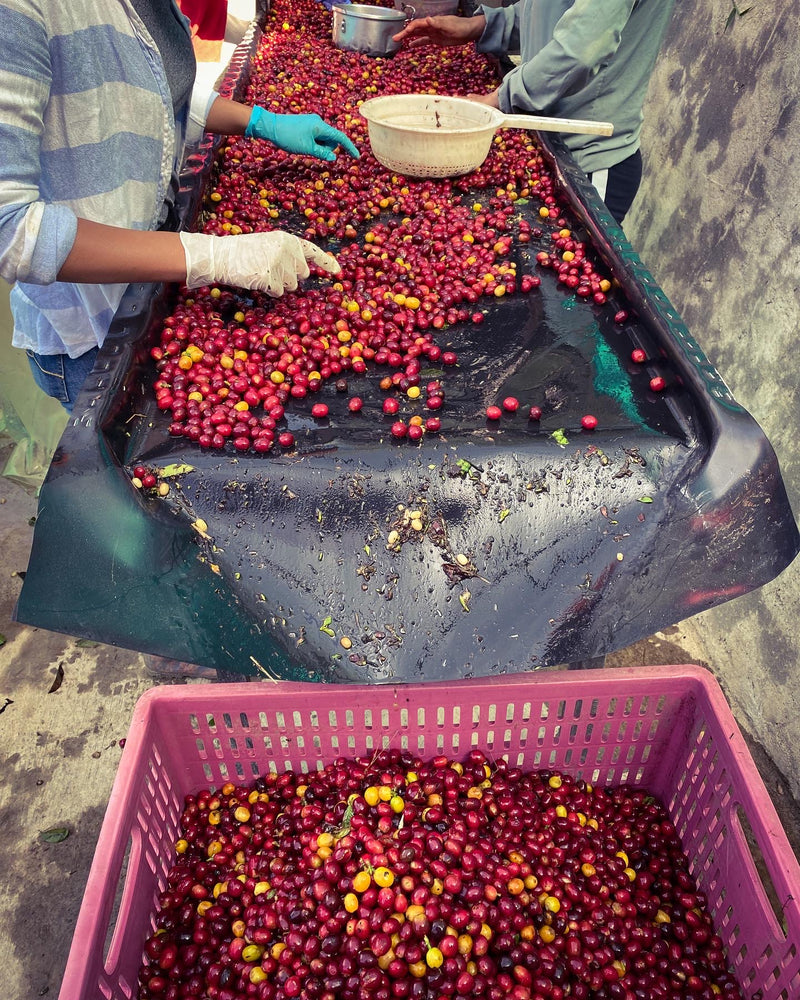
About Process
Dripper: Hario V60 Dripper
・Coffee : Water Ratio: 14g : 200g
・Water temp.: 94℃
・Grind: Coarse
Step by step:
00:00~ 40g(Total: 40g)
00:40~ +60g(Total: 100g)
01:10~ +50g(Total: 150g)
01:40~ +50g(Total: 200g)
Finish brew: Approx. 02:30
::::::::::::::::::::::::::::::::::::
Iced ( Drip on ice) // Dose 16g :: Water 150g : Ice 90g
How to Brew
0:00 ~30g
0:30 +60g (Total 90g)
1:10~1:20 +60g (Total 150g)
Finish brew: Approx. 02:10
Materials
Materials
About Yamato Toujiki
Arita, one of the most prestigious pottery producing regions of Japan, has been playing a fundamental role in providing trusty products to support Japanese culinary culture for more than 400 years. Among the manufacturers we met in Arita, Yamato Toujiki is one that was flexible and open to new designs and ideas, while still embracing traditional techniques.
The craftspeople there are truly meticulous in their work, not overlooking even the slightest difference in shape and carefully finishing each piece one by one.
As we went though countless prototypes, their professional inputs such as “this thickness tends to deform after firing” or “the angle of this curve could be adjusted a little more” has given us many new perspectives to give the design we envisioned an actual shape.
The precision in the craftspeople’s work we witnessed on our visit to Arita was truly remarkable. How they used potter’s wheel so naturally like breathing, and how a beautiful shape emerges from it- the moment we saw it, we realized that we are not just making something but also passing on this culture of the art.
Another thing that stuck with us was the atmosphere of the workshop. It was quiet but full of energy at the same time, the air filled with history and a proud craftspersonship.
“You never know until it comes out of the oven” they said- that’s why they treat each and every piece with such attention and precision, making adjustment along the way as needed. In their such work ethics we saw a shared sense of pursuing the ideal with our product designing process.
Kyoto Series is a product born through the hands of such craftspeople- it would be our pleasure if you could feel the warmth of human touch and their stories as you sip.
Dimensions
Dimensions
Product Specifications
3oz(95ml)
W80×H15.3×D55㎜
Diameter (Mouth opening): 55㎜
Capacity: 95ml
Weight: 90g
With package
W90×H52×D53㎜
Weight: 130g
6oz(185ml)
W95×H75×D70㎜
Diameter (Mouth opening): 70㎜
Capacity: 185ml
Weight: 160g
With package
W110×H80×D90㎜
Weight: 210g
8oz(250ml)
W105×H75×D80㎜
Diameter (Mouth opening): 80
Capacity: 250ml
Weight: 190g
With package
W120×H90×D90㎜
Weight: 260g
Made in Saga, Japan
Semi-porcelain
Sagan/Hasami
Care information
Care information
Maintenance Tips
While the product is dishwasher-safe, hand-washing is recommended for the product to last longer.
Scrubbing with abrasive detergent or metal scrubbers may scratch the product, so please wash with a soft sponge.
Avoid soaking the product in water for long. After washing, wipe with a soft dry cloth and dry well before storing in a well-ventilated place.
Please be careful not to apply strong impact, to avoid chipping and cracking.
Other note
Do not use in an oven, induction cooker, or over an open flame.
While this product is microwave-safe, do not use it without food on it or heat it for an extended period of time.
Sudden temperature changes (rapid heating and cooling) may damage the product. Even partial temperature changes may cause damage.
If cracks or fissures appear, stop using the product for safety reasons.
The surface of the product may develop small cracks during use, but this does not affect the quality nor usability. As the product is handmade, there may be individual differences in color and shape.
![*new【Roast in Kyoto】[Premium]Colombia Oscar Hernandez Bourbon Pimienta [Light roast]](http://kurasubkk.com/cdn/shop/files/image_Beans_Premium-Colombia-Oscar-Hernandez-2026_5000x_8c31ebc6-b469-469c-913c-b49f00d112ea.webp?v=1785903609&width=1445)
![*new【Roast in Kyoto】[Premium]Colombia Oscar Hernandez Bourbon Pimienta [Light roast]](http://kurasubkk.com/cdn/shop/files/Premium_Colombia_Oscar_Hernandez_2026-100_1_5000x_a1f6b3f0-70c7-4add-8434-dfc7f83a094a.webp?v=1785903609&width=1445)
![*new【Roast in Kyoto】[Premium]Colombia Oscar Hernandez Bourbon Pimienta [Light roast]](http://kurasubkk.com/cdn/shop/files/ColombiaOscarHernandezBourbonPimienta2026-100_1_5000x_1bf8a29e-5d84-4edd-a6c9-4698853a3a2d.webp?v=1785903609&width=1445)