ข้ามไปยังข้อมูลสินค้า
1 จาก 3

Kurasu Thailand

*new【Roast in Kyoto】Rwanda Nkara Soil Project Lot.1204[Medium-light roast]

*new【Roast in Kyoto】Rwanda Nkara Soil Project Lot.1204[Medium-light roast]

ราคาปกติ 460.00 ฿ THB
ราคาปกติ ราคาช่วงลดราคา 460.00 ฿ THB
การลดราคา ขายหมดแล้ว
รวมภาษี ค่าจัดส่งที่คำนวณในขั้นตอนการชำระเงิน
Size

Roasted in Kyoto

Floral aroma, taste of mandarin orange, baked apple and grapefruit, brown sugar-like sweetness and accompanying aftertaste.

Coffee Profile


Roast Level Medium-light
Country Rwanda
Region Gakenke
Factory Dukunde Kawa, Musasa Cooperative
Altitude 1,800-2,100m
Variety Red Bourbon
Process Fully Washed
Flavor note Floral, Mandarin orange, Baked apple, Grapefruit, Brown sugar, Japanese black tea


Product Details


Roaster's Comment

This year, we sourced two lots from Rwanda. For the first release, we are pleased to introduce a coffee produced through the Soil Project at Nkara CWS.

The Soil Project is a sustainable initiative in which farmers create their own compost using coffee pulp—a byproduct of coffee production—and use it to grow coffee seedlings. The project began in 2023, when the team from ONIBUS COFFEE visited the region and helped launch the initiative. This coffee comes from the second harvest since the Soil Project was completed as a designated lot.

Nkara CWS, like Ruli CWS that we introduced last year, is a washing station managed by the Dukunde Kawa Musasa Cooperative. Both are located in the Gakenke District in northern Rwanda, yet their flavor profiles are subtly different. Last year’s Ruli lot stood out for its concentrated fruit sweetness, reminiscent of apricot and raisin. In contrast, this Nkara lot is characterized by juicy citrus notes, similar to Japanese mandarin orange and grapefruit, followed by a deep, lingering finish that recalls roasted hojicha tea. Rwanda is often thought to have relatively little regional flavor variation due to its small land area, but by introducing coffees year after year, we continue to sense the presence of distinct microclimates within the country.

With its juicy body and well-defined sweetness, this coffee has great potential not only as a filter brew but also when paired with milk. To highlight this versatility, we roasted it slightly more developed than Kurasu’s usual light roast. The result is a cup that is approachable even for those who don’t typically drink light-roasted coffee, and one we hope you’ll enjoy across a wide range of occasions.

Factory's Note

Nkara CWS began operations in 2008 as the third washing station established by the Dukunde Kawa Musasa Cooperative. While Nkara is relatively small compared to the cooperative’s other stations, it is equipped with modern facilities and is known for its high level of processing expertise.

Located in a cool climate nestled between rolling hills, the Nkara area provides ideal conditions for coffee cultivation throughout the year. These cooler temperatures allow coffee cherries to develop slowly and densely, resulting in rich flavors and well-developed sweetness.

The soil consists of fertile loam, and temperatures remain stable year-round at around 17–18°C. Coffee trees are planted at approximately 2.2-meter intervals, with about 2,500 trees cultivated per hectare. On average, each farmer manages around 250 trees, allowing for careful cultivation by small-scale producers. The area is also certified by multiple international standards, including Fairtrade and Rainforest Alliance.

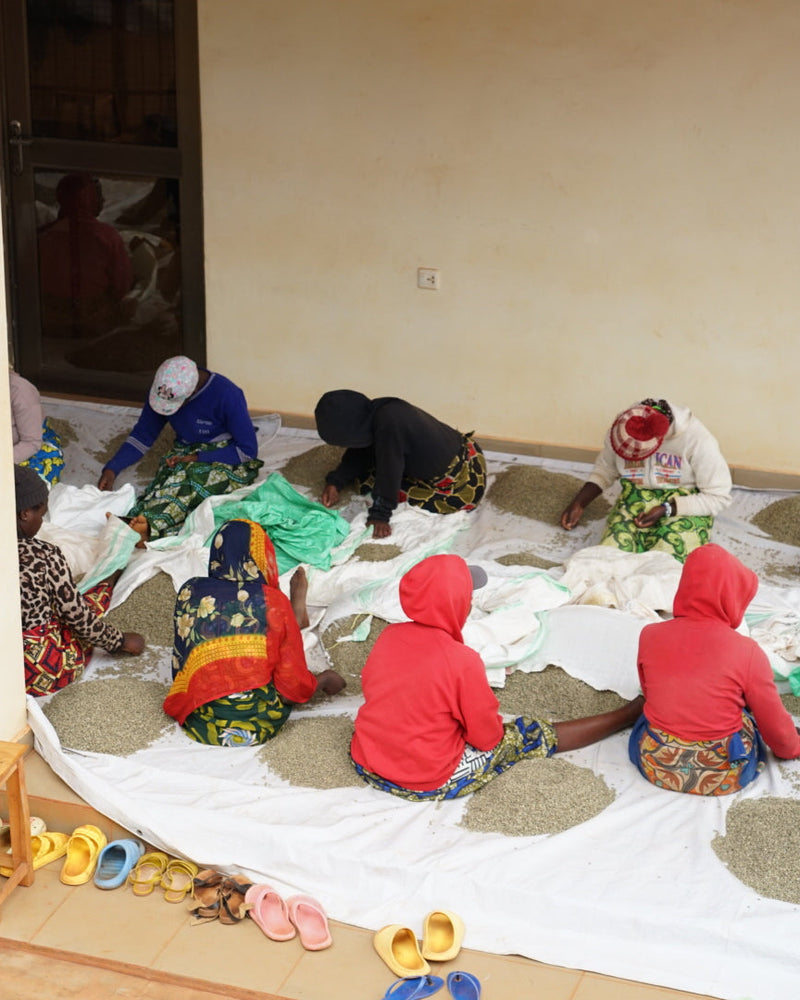
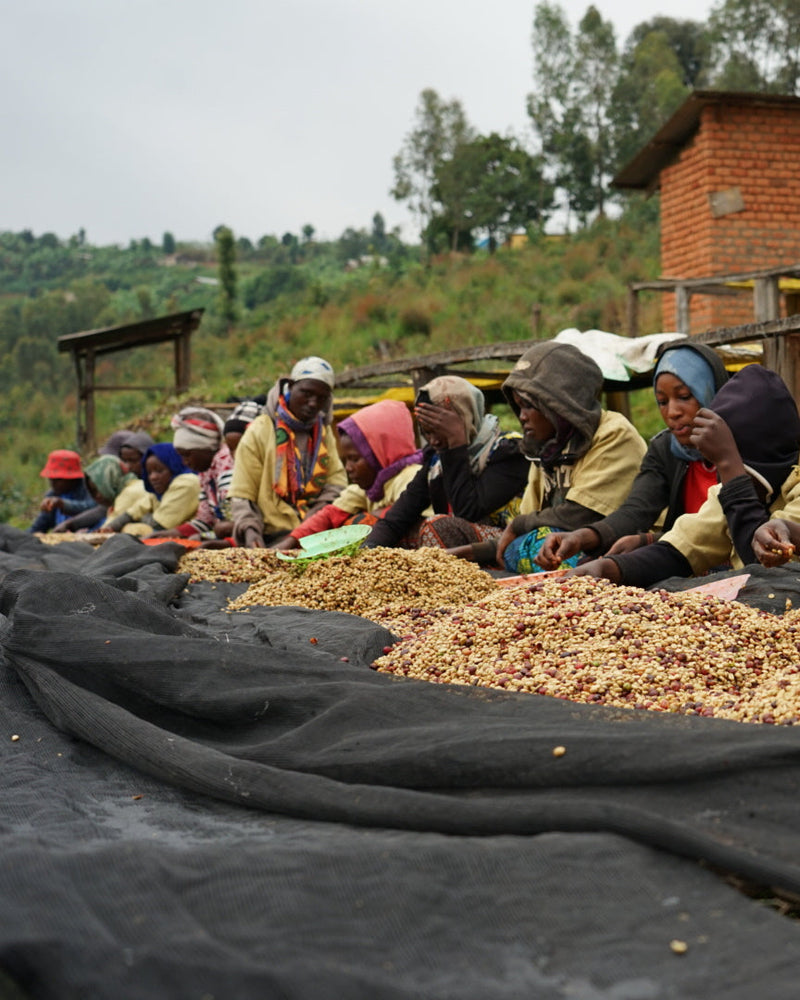
Cherries delivered to Nkara CWS are first sorted on African tables, followed by flotation to remove low-density cherries. They then undergo pulping and density separation using water, ensuring thorough removal of defects. Hand-picking is carried out repeatedly, both while the coffee is wet and during the drying process. After an 18-hour dry fermentation, the coffee is dried under the sun on African beds, with careful control to maintain moisture levels at around 12%, resulting in high-quality green beans.

Once drying is complete, the coffee is processed at the cooperative’s dry mill in Luli before being shipped to international markets. Lots are carefully separated by harvest date, ensuring full traceability.

Coffees produced in the Nkara area are characterized by fruity flavors, rich sweetness, and a well-structured body, shaped by the region’s high altitude, cool climate, and fertile soils.


DukundeKawa - Musasa Cooperative Ernest NSHIMYIMANA
The Dukunde Kawa Musasa Cooperative was established in 2000 in the Gakenke District of northern Rwanda. “Dukundekawa” means “love coffee” in Kinyarwanda, while “Musasa” refers to the name of the local area.

The cooperative is made up of approximately 300 farmers, around 20% of whom are women. Nearby lies Gorilla Mountain, known for its population of mountain gorillas, and within this rich natural environment the cooperative produces high-quality Bourbon coffee.

Across all of its washing stations, Dukunde Kawa Musasa maintains rigorous sorting and processing standards, with thorough quality control carried out through to export at the on-site dry mill. Another hallmark of the cooperative is its meticulous lot separation by individual harvest day, ensuring a high level of traceability.

In recent years, the cooperative has also opened a cafe at a scenic location within its facilities, creating barista positions in the process. This cafe serves as a source of employment and income outside the harvest season, as well as a space to present Rwandan coffee to both domestic and international audiences. Such well-developed facilities and a strong commitment to improvement make it possible to consistently produce high-quality coffee.

The Dukunde Kawa Cooperative holds several international certifications, including Rainforest Alliance and Fairtrade. Through Fairtrade, the cooperative works to improve farmers’ livelihoods while promoting the development of a coffee industry that is economically and environmentally sustainable. Its dedication to quality has been widely recognized, most notably with a second-place award at the Rwanda Cup of Excellence in 2010.


Dripper: Hario V60 Dripper
Coffee : Water Ratio: 14g : 200g
Water temp.: 94
Grind: Coarse

Step by step:

00:00~ 40g(Total: 40g)
00:40~ +60g(Total: 100g)
01:10~ +50g(Total: 150g)
01:40~ +50g(Total: 200g)

Finish brew: Approx. 02:30

::::::::::::::::::::::::::::::::::::


Iced ( Drip on ice) // Dose 16g :: Water  150g : Ice 90g

How to Brew
0:00 ~30g
0:30  +60g  (Total 90g)
1:10~1:20    +60g  (Total 150g)

Finish brew: Approx. 02:10

Materials

About Yamato Toujiki

Arita, one of the most prestigious pottery producing regions of Japan, has been playing a fundamental role in providing trusty products to support Japanese culinary culture for more than 400 years. Among the manufacturers we met in Arita, Yamato Toujiki is one that was flexible and open to new designs and ideas, while still embracing traditional techniques.

The craftspeople there are truly meticulous in their work, not overlooking even the slightest difference in shape and carefully finishing each piece one by one.

As we went though countless prototypes, their professional inputs such as “this thickness tends to deform after firing” or “the angle of this curve could be adjusted a little more” has given us many new perspectives to give the design we envisioned an actual shape.

The precision in the craftspeople’s work we witnessed on our visit to Arita was truly remarkable. How they used potter’s wheel so naturally like breathing, and how a beautiful shape emerges from it- the moment we saw it, we realized that we are not just making something but also passing on this culture of the art.

Another thing that stuck with us was the atmosphere of the workshop. It was quiet but full of energy at the same time, the air filled with history and a proud craftspersonship.

“You never know until it comes out of the oven” they said- that’s why they treat each and every piece with such attention and precision, making adjustment along the way as needed. In their such work ethics we saw a shared sense of pursuing the ideal with our product designing process.

Kyoto Series is a product born through the hands of such craftspeople- it would be our pleasure if you could feel the warmth of human touch and their stories as you sip.

Dimensions

Product Specifications
3oz(95ml)
W80×H15.3×D55㎜
Diameter (Mouth opening): 55㎜
Capacity: 95ml
Weight: 90g
With package
W90×H52×D53㎜
Weight: 130g

6oz(185ml)
W95×H75×D70㎜
Diameter (Mouth opening): 70㎜
Capacity: 185ml
Weight: 160g
With package
W110×H80×D90㎜
Weight: 210g

8oz(250ml)
W105×H75×D80㎜
Diameter (Mouth opening): 80
Capacity: 250ml
Weight: 190g
With package
W120×H90×D90㎜
Weight: 260g

Made in Saga, Japan
Semi-porcelain
Sagan/Hasami

Care information

Maintenance Tips

While the product is dishwasher-safe, hand-washing is recommended for the product to last longer.

Scrubbing with abrasive detergent or metal scrubbers may scratch the product, so please wash with a soft sponge.
Avoid soaking the product in water for long. After washing, wipe with a soft dry cloth and dry well before storing in a well-ventilated place.
Please be careful not to apply strong impact, to avoid chipping and cracking.

Other note

Do not use in an oven, induction cooker, or over an open flame.

While this product is microwave-safe, do not use it without food on it or heat it for an extended period of time.

Sudden temperature changes (rapid heating and cooling) may damage the product. Even partial temperature changes may cause damage.

If cracks or fissures appear, stop using the product for safety reasons.

The surface of the product may develop small cracks during use, but this does not affect the quality nor usability. As the product is handmade, there may be individual differences in color and shape.

ดูรายละเอียดทั้งหมด